



After 49 years in space, Nasa’s Voyager 1 probe one light-day away from Earth
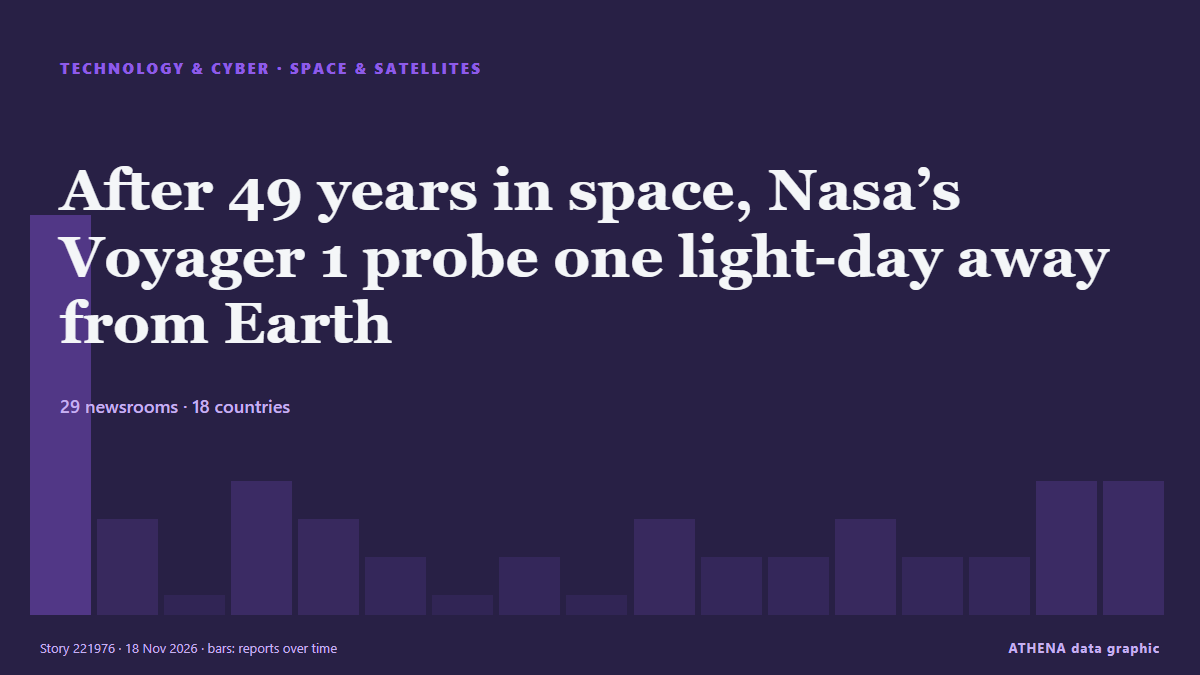
Nasa’s Voyager 1 probe, which has been travelling through space for nearly 50 years, hit a milestone distance of one light-day away from Earth on Wednesday. from Dawn
Reported independently by 29 outlets in 18 countries since 14 Nov, first by CNA (Channel NewsAsia); coverage is fading. ATHENA rates the risk low (1.9/10), driven mainly by the severity of the harm described and its geographic and sector reach. Confidence is 89% (high), with 29 independent outlets corroborating it and an average source reliability of 73%. Outlets by country: United States (9), India (4), United Kingdom (3). Coverage: 14 Nov to 18 Nov, 97 hours.
Why it matters: Technology and cyber developments shape security, competition and the rules of digital life.
What changed: 11 new reports from 9 outlets in the 24 hours to 18 Nov.
First reported as: NASA's Voyager 1 probe poised to achieve mega-distance milestone
AutomatedSelected, grouped and scored by ATHENA's published method from 29 independent outlets. The headline is the outlet's own; ATHENA's sentences follow fixed patterns - no generative AI writes them. How it works →
How to read this page
- What you are reading
- 29 outlets in 18 countries reported this event. The reports below are listed in the order they appeared; each headline opens the original article. ATHENA writes none of the reports.
- Our reading
- For the record — The reports describe a completed, domestic, commercial or personal matter. We list it so you can see who reported it and when. We are not tracking a risk of wider conflict here.
- How much evidence
- Fair Several independent outlets agree, but the picture could still change.
After repeats, off-topic items and stale reports are removed, 23 of the 34 listed reports are counted; 100% of the headlines match the event.
- What this does not mean
- ATHENA measures how an event is reported, not whether it is true. This is not a forecast, a judgement on who is right, or advice.
- What would change it
- Reports from other independent outlets showing a different development, or a firm confirmation or denial from an official source.
Reading R2 · refreshed with every update of this page. ATHENA has not yet published a track record for these readings; when it does, it will be linked here.
At a glance
Selected, scored and written by ATHENA's published methodology. No editor intervenes in individual events. How this is produced ›
| 14 Nov 11:02 UTC | 10 |
|---|---|
| 14 Nov 17:02 UTC | 2 |
| 14 Nov 23:02 UTC | 0 |
| 15 Nov 05:02 UTC | 3 |
| 15 Nov 11:02 UTC | 2 |
| 15 Nov 17:02 UTC | 1 |
| 15 Nov 23:02 UTC | 0 |
| 16 Nov 05:02 UTC | 1 |
| 16 Nov 11:02 UTC | 0 |
| 16 Nov 17:02 UTC | 2 |
| 16 Nov 23:02 UTC | 1 |
| 17 Nov 05:02 UTC | 1 |
| 17 Nov 11:02 UTC | 2 |
| 17 Nov 17:02 UTC | 1 |
| 17 Nov 23:02 UTC | 1 |
| 18 Nov 05:02 UTC | 3 |
| 18 Nov 11:02 UTC | 4 |
Why these numbers
Importance
Risk
Confidence
The reporting — who reported it, and when
headline as published · opens the original- CNA (Channel NewsAsia) · SingaporeNASA's Voyager 1 probe poised to achieve mega-distance milestone
- Free Malaysia Today · MalaysiaNasa’s Voyager 1 probe poised to achieve mega-distance milestone
- The Canadian Press (via CityNews) · CanadaNASA’s Voyager 1 closes in on a light-day in interstellar space for a new distance record
- Belfast Telegraph · United KingdomVoyager 1 closes in on light-day milestone in interstellar space
- The Irish News (Belfast) · United KingdomVoyager 1 closes in on light-day milestone in interstellar space
- Times of India · IndiaHumanity's farthest messenger: Nasa's Voyager 1 nears a one light-day milestone
- TheJournal.ie · IrelandVoyager 1, launched in 1977, to become humanity’s first object to reach one light-day from Earth
- Bangkok Post — page reader · ThailandVoyager 1 nears another remarkable milestone
- Al Jazeera English · QatarNASA’s Voyager 1 to hit new space distance record of one light-day
- Courthouse News · United StatesNASA’s Voyager 1 closes in on a light-day in interstellar space for a new distance record
- Phys.org · United KingdomNASA's Voyager 1 closes in on a light-day in interstellar space for a new distance record
- Colombia One · ColombiaNASA’s Voyager 1 Nears Historic One-Light-Day Distance From Earth
- IOL · South AfricaNASA invites people worldwide to shine a light as Voyager 1 reaches historic milestone
- The Business Standard (Bangladesh) (working feed) · BangladeshGive Voyager 1 a flash: Nasa calls for a global light show on 17 November
- Express Tribune · PakistanNASA's Voyager 1 probe poised to achieve mega-distance milestone
- Anadolu Agency (English) · TurkeyNASA's Voyager 1 to reach historic one-light-day distance from Earth on Nov. 18
- Ada Derana · Sri LankaNASA’s Voyager 1 nears historic milestone of reaching one light-day from earth
- NPR · United StatesFar from home. Voyager 1 is now farther than anything man has sent into space
- Space.com · United StatesNASA's interstellar Voyager 1 probe is about to reach 1 light-day from Earth after nearly 50 years in space
- DW English · GermanyNASA's Voyager 1 reaches a light-day away from Earth
- Space.com · United StatesWhat exactly is a light-day? Here's what Voyager 1's latest milestone means for the interstellar probe
- ScienceAlert · AustraliaVoyager 1 Has Sped Through Space at 38,000 Mph Since 1977. This Wednesday, It Will Finally Reach 1 Light-Day From Earth.
- Los Angeles Times (World) · United StatesNASA's Voyager 1 will soon be so far away that its messages take a day to reach Earth
- Indian Defence Review · IndiaVoyager 1 Has Been Traveling at 38,000 Mph for 49 Years. This Wednesday, It Will Reach a Historic Milestone
- Space.com · United StatesNASA wants you to 'shine bright' today for Voyager 1's light-day milestone. Here's how
- Space.com · United StatesNASA's Voyager 1 launched second, so how did it beat Voyager 2 to a light-day by nearly a decade?
- Indian Express · IndiaAfter half a century in space, one light-day milestone in sight: What makes Voyager 1’s journey a feat of humankind
- Deccan Herald · IndiaVoyager 1's 'one light day' from Earth: Another milestone in a journey of never turning back
- ScienceAlert · AustraliaIt's Official! Voyager 1 Is The First Spacecraft To Reach One Light-Day From Earth
- The Straits Times · SingaporeNASA Voyager 1 probe believed to have reached 'light-day' milestone
- Rappler · PhilippinesNASA Voyager 1 probe believed to have reached ‘light-day’ milestone
- Space.com · United States1 light-day from Earth! NASA's Voyager 1 probe hits huge milestone in interstellar space
- Dawn · PakistanAfter 49 years in space, Nasa’s Voyager 1 probe one light-day away from Earth
- Tom's Hardware · United StatesVoyager 1 spacecraft crosses milestones distance of one-light day from Earth 49 years after launch