



Voyager 1 spacecraft reaches one light-day milestone
The spacecraft is now about 26 billion kilometres (16 billion miles) away, according to NASA. from Express Tribune
Reported independently by 6 outlets in 4 countries since 18 Nov, first by Express Tribune; coverage is fading. ATHENA finds no risk indicators in the coverage. Confidence is 79% (high), with 6 independent outlets corroborating it and an average source reliability of 70%. Outlets by country: United States (3), Pakistan (1), Malaysia (1). Coverage: 18 Nov to 18 Nov, 6 hours.
Why it matters: Technology and cyber developments shape security, competition and the rules of digital life.
What changed: 6 new reports from 6 outlets in the 24 hours to 18 Nov.
First reported as: After 49 years, Nasa’s Voyager 1 is one light-day away from us. Can we save this ‘pale blue dot’? |
AutomatedSelected, grouped and scored by ATHENA's published method from 6 independent outlets. The headline is the outlet's own; ATHENA's sentences follow fixed patterns - no generative AI writes them. How it works →
How to read this page
- What you are reading
- 6 outlets in 4 countries reported this event. The reports below are listed in the order they appeared; each headline opens the original article. ATHENA writes none of the reports.
- Our reading
- For the record — The reports describe a completed, domestic, commercial or personal matter. We list it so you can see who reported it and when. We are not tracking a risk of wider conflict here.
- How much evidence
- Limited Treat this page as an early report.
After repeats, off-topic items and stale reports are removed, 5 of the 6 listed reports are counted; 100% of the headlines match the event.
About 40% of the headlines are analysis or opinion rather than straight reporting.
- What this does not mean
- ATHENA measures how an event is reported, not whether it is true. This is not a forecast, a judgement on who is right, or advice.
- What would change it
- Reports from other independent outlets showing a different development, or a firm confirmation or denial from an official source.
Reading R2 · refreshed with every update of this page. ATHENA has not yet published a track record for these readings; when it does, it will be linked here.
At a glance
Selected, scored and written by ATHENA's published methodology. No editor intervenes in individual events. How this is produced ›
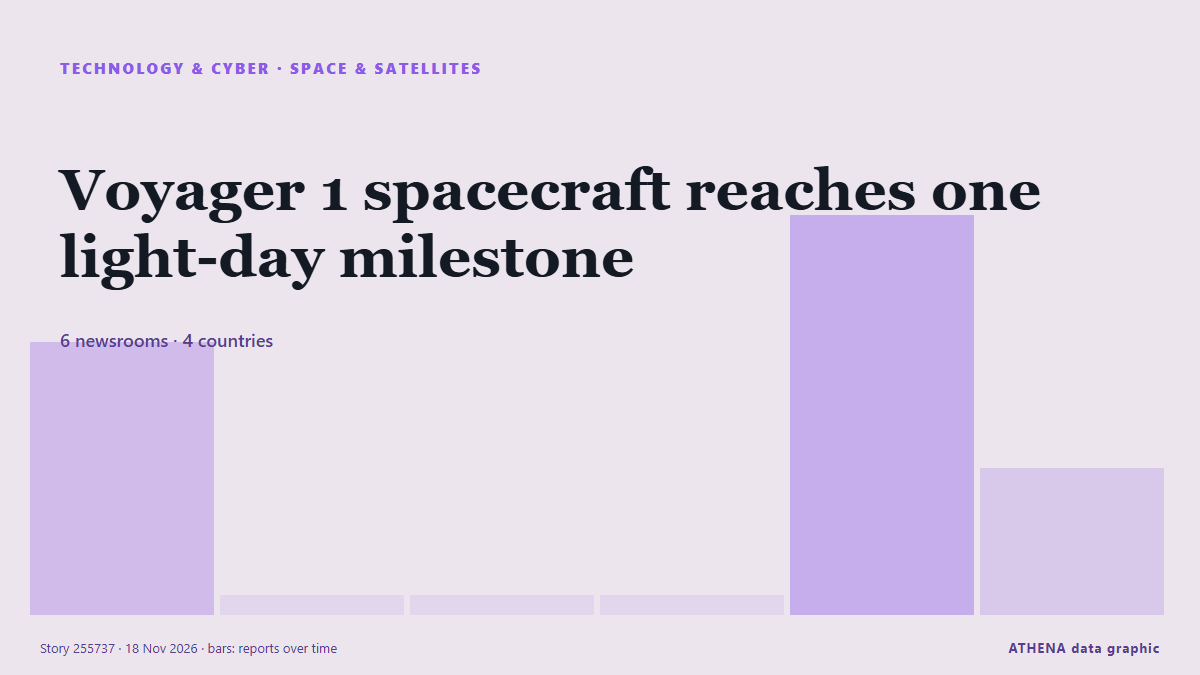
| 18 Nov 06:21 UTC | 2 |
|---|---|
| 18 Nov 07:21 UTC | 0 |
| 18 Nov 08:21 UTC | 0 |
| 18 Nov 09:21 UTC | 0 |
| 18 Nov 10:21 UTC | 3 |
| 18 Nov 11:21 UTC | 1 |
Why these numbers
Importance
Risk
Confidence
The reporting — who reported it, and when
headline as published · opens the original- Express Tribune · PakistanVoyager 1 spacecraft reaches one light-day milestone
- Big Think · United StatesHow Voyager 1 became the first spacecraft to reach one light-day
- Free Malaysia Today · MalaysiaVoyager 1 spacecraft reaches one light-day milestone
- Guardian Environment · United KingdomAfter 49 years, Nasa’s Voyager 1 is one light-day away from us. Can we save this ‘pale blue dot’? |
- Wired · United StatesVoyager 1 Beat the Odds and Is Still Working a Light-Day Away From Earth
- Ars Technica · United StatesVoyager 1 at one light-day: Historian revisits Golden Record's forgotten details