



US Robot Submarine Finds World’s Deepest Explosive Volcanic Eruptions In Mariana Trench
Scientists sampling the Mariana Trench walls found pyroclastic rock at 6,148 metres, the deepest sign of explosive eruptions ever found in the ocean. from Marine Insight
What changed 2 new reports from 2 outlets in the last 24 hours.
See the sources ›Evidence: Limited
Reported independently by 4 outlets in 3 countries since 23 Nov, first by Science News; coverage is fading. ATHENA finds no risk indicators in the coverage. Confidence is 64% (moderate), with 4 independent outlets corroborating it and an average source reliability of 73%. Outlets by country: India (2), United States (1), United Kingdom (1). Coverage: 23 Nov to 24 Nov, 32 hours.
Why it matters: Technology and cyber developments shape security, competition and the rules of digital life.
What changed: 2 new reports from 2 outlets in the 24 hours to 24 Nov.
First reported as: Robot submarine exploring world's deepest ocean trench finds unprecedented volcanic activity
AutomatedSelected, grouped and scored by ATHENA's published method from 4 independent outlets. The headline is the outlet's own; ATHENA's sentences follow fixed patterns - no generative AI writes them. How it works →
How to read this page
- What you are reading
- 4 outlets in 3 countries reported this event. The reports below are listed in the order they appeared; each headline opens the original article. ATHENA writes none of the reports.
- Our reading
- For the record — The reports describe a completed, domestic, commercial or personal matter. We list it so you can see who reported it and when. We are not tracking a risk of wider conflict here.
- How much evidence
- Limited Treat this page as an early report.
After repeats, off-topic items and stale reports are removed, 4 of the 4 listed reports are counted; 100% of the headlines match the event.
- What this does not mean
- ATHENA measures how an event is reported, not whether it is true. This is not a forecast, a judgement on who is right, or advice.
- What would change it
- Reports from other independent outlets showing a different development, or a firm confirmation or denial from an official source.
Reading R2 · refreshed with every update of this page. ATHENA has not yet published a track record for these readings; when it does, it will be linked here.
At a glance
Selected, scored and written by ATHENA's published methodology. No editor intervenes in individual events. How this is produced ›
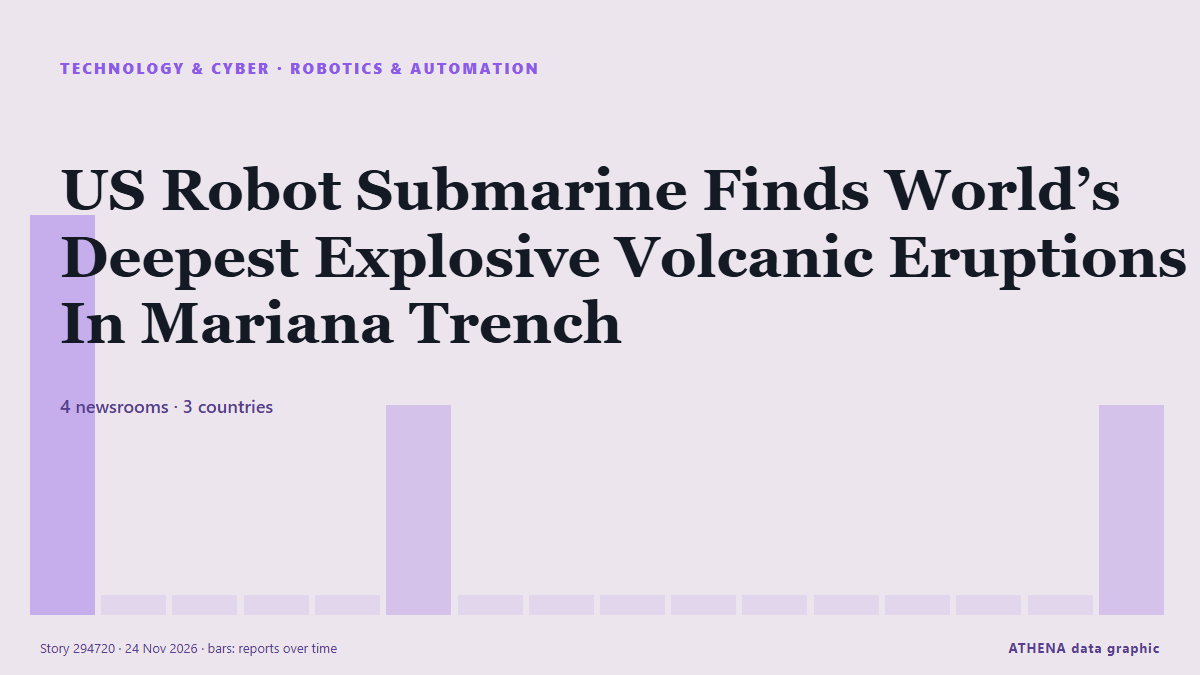
| 23 Nov 05:00 UTC | 2 |
|---|---|
| 23 Nov 07:00 UTC | 0 |
| 23 Nov 09:00 UTC | 0 |
| 23 Nov 11:00 UTC | 0 |
| 23 Nov 13:00 UTC | 0 |
| 23 Nov 15:00 UTC | 1 |
| 23 Nov 17:00 UTC | 0 |
| 23 Nov 19:00 UTC | 0 |
| 23 Nov 21:00 UTC | 0 |
| 23 Nov 23:00 UTC | 0 |
| 24 Nov 01:00 UTC | 0 |
| 24 Nov 03:00 UTC | 0 |
| 24 Nov 05:00 UTC | 0 |
| 24 Nov 07:00 UTC | 0 |
| 24 Nov 09:00 UTC | 0 |
| 24 Nov 11:00 UTC | 1 |
Why these numbers
Importance
How widely and how prominently the story is reported.
Risk
What the reports describe, scored for possible harm. It is not a forecast.
Confidence
How well independent outlets support the story.
Shown as 64% (calculated 72%): the evidence reading is Limited, so confidence is held at moderate.
The reporting — who reported it, and when
headline as published · opens the original- Science News · United StatesMotion under the ocean explains the depth of the world’s deepest spot
- Phys.org · United KingdomRobot submarine exploring world's deepest ocean trench finds unprecedented volcanic activity
- Indian Defence Review · IndiaScientists Sent a Robot Into the Mariana Trench and Found Rock That Shouldn’t Be There
- Marine Insight · IndiaUS Robot Submarine Finds World’s Deepest Explosive Volcanic Eruptions In Mariana Trench